


Game-changer or gimmick – Ducati's adaptive maintenance system explored and explained
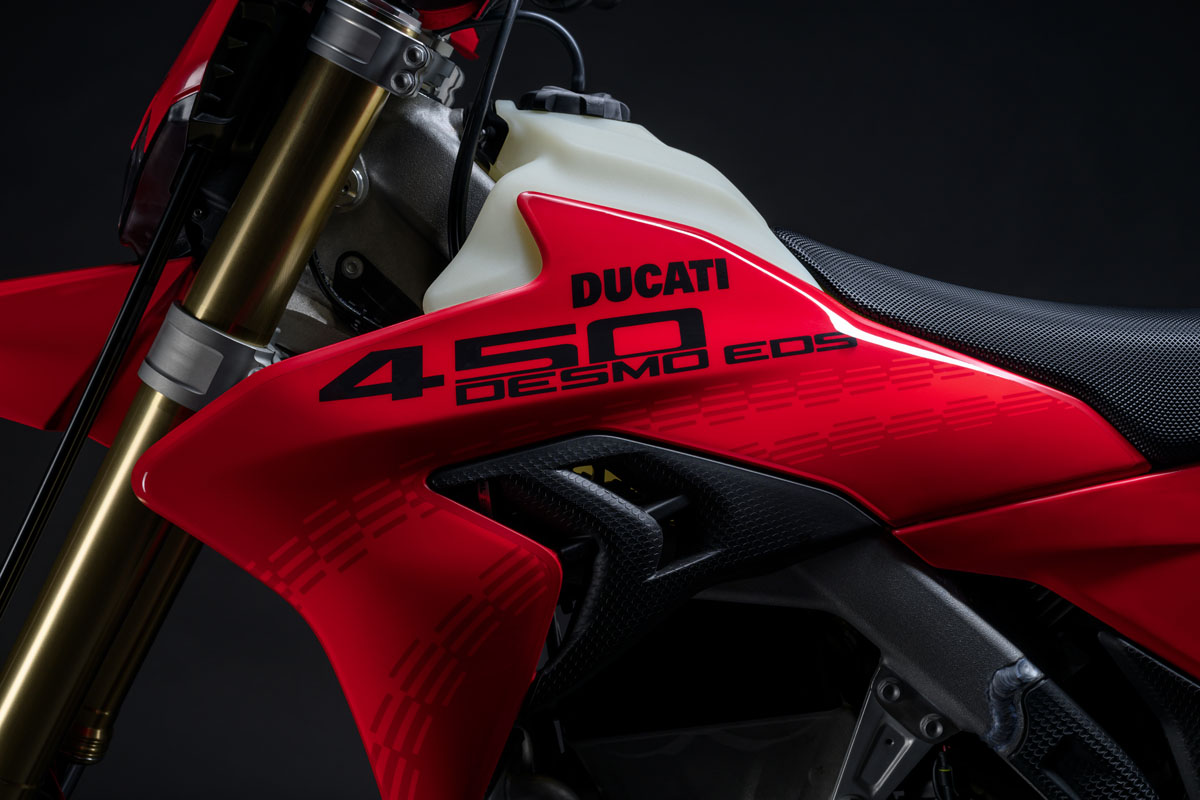
Ducati’s newly launched Desmo450 EDS is set to land in dealerships in just a few days, bringing with it a never-before-seen feature for the enduro market in the form of an algorithm-based adaptive maintenance system, on hand to tell you just how much fettling the bike requires based on how it’s actually being ridden.
It is designed to estimate engine stress based on riding data and adjust maintenance recommendations accordingly. That all sounds very good, and potentially a genuinely handy bit of kit to have – or is it just another gimmick?
We picked up the phone and dialled up Ducati HQ to get the full lowdown on how the system works, speaking to the Italian marque’s off-road technical director, Davide Perni, to truly get to grips with just what adaptive maintenance can do, and what the limitations are.
MotoGP beginnings
To start, we need to look back to 2004 when the Grand Prix Commission introduced a nine-engine cap for all MotoGP teams, later dropping this to a six-motor limit in 2010, before upping it again to seven for the 2016 season.
By limiting the number of engines available throughout the season, greater focus was needed on reliability and longevity, and one of the ways this was achieved was by measuring component stress throughout a variety of conditions, before applying the findings to software that could predict wear rates in real time.
As Perni explains: “We started to work to understand the life of the engine not based on mileage, because 100km in one circuit creates a different level of damage compared with another. It is the way you use the engine that creates what we call the ‘accumulation of damage’.
“Every minute you create a small amount of damage. How big that damage is depends on temperature, engine revs and throttle position. If you count all this damage, you arrive at the end of the life of some components. This is, in a simple way, how the algorithm works for our MotoGP [and Superbike] engine.”
With the 450, the task became first establishing those baseline wear calculations, before building an algorithm around the results. The earlier launched MX model went first, with nine-time Motocross World Champion Tony Cairoli setting the benchmarks, before the system could be tweaked again for the EDS model.
“For the Desmo450, we adapted [the predictive maintenance system]. We first measured the fatigue that we put on the engine starting simply by physically measuring wear.
“We took Tony Cairoli and we put him on tracks around Europe. We then took the profile of his riding and that forms the profile for the use of the bike. We took the most stressful profile and replicated these on the test bench.
“Every ten hours we opened the engine and measured the hardness of the components. Eventually, at around 63 hours, we saw that the hardness of the piston dropped below our minimum level, so we stopped there. Then we added a safety margin for the tolerances of mass production and reduced the service interval to 45 hours [for the 450 MX].
“If you ride like Cairoli, 45 hours is correct. If you do not ride like him, you can change the piston at 50, 55 or 60 hours because the stress on the components is less. If you are faster than him, maybe you need to change it before 45 hours. The algorithm is working to calculate exactly the stress that your riding is putting on the mechanical components,” Perni added.
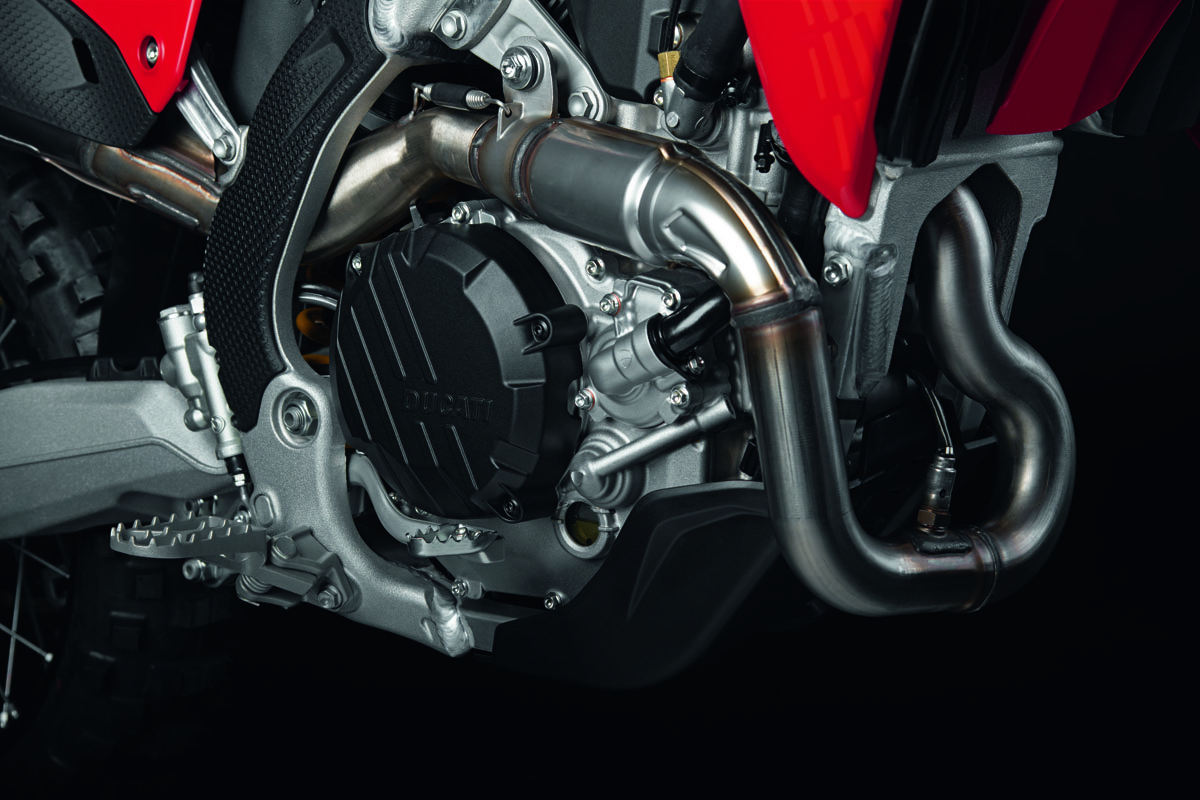
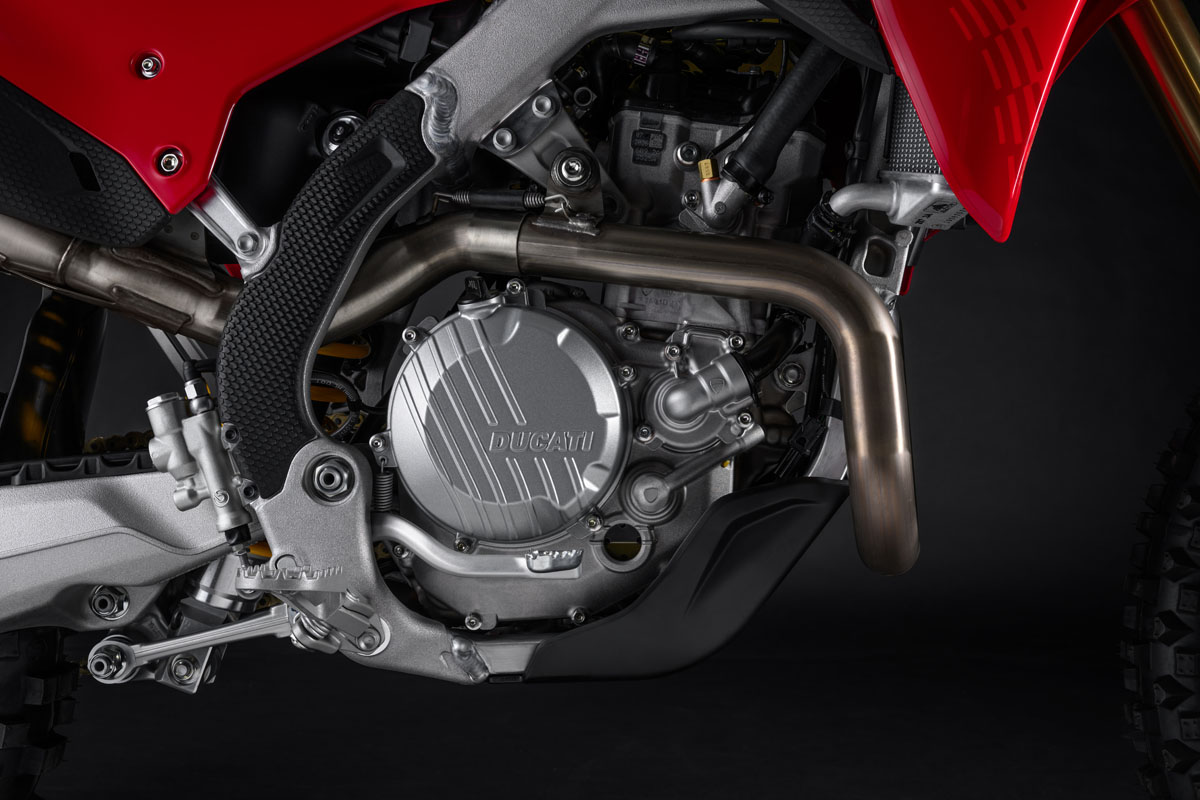
At this stage, it’s worth mentioning that the tech, while clever, does not actually ‘monitor’ wear as such. There are no special sensors calculating the presence of bearing or clutch material in the bike’s oil. Engine component conditions are not actually assessed in situ; the bike’s ECU simply works out how hard it has been ridden based on throttle input, temperature, and engine speed to estimate the cumulative stress being placed on internals.
The system feeds information to Ducati’s smartphone app, then advising owners when service work is required on a user-specific basis. Ergo, if you ride fast and hard, your bike will tell you it needs love more often. Baby it and the system will stretch service intervals beyond the baseline hours prescribed in the manual.
It is not a magic solution capable of detecting every possible issue, nor can it catch problems early. The algorithm relies on existing sensors and cannot respond to problems of neglect.
“If you don’t fit the air filter properly and sand gets inside, the system cannot understand this,” Perni explained.
“There are no cameras or special sensors. If you don’t check the oil level and fail to refill it, the system cannot take that into consideration.
“But if you make the right maintenance, the system is able to tell you how much you can stretch the service intervals.”
Building the EDS algorithm
“For the 450 EDS, we took the same algorithm [as the MX] and swapped it to the enduro world, where the average stress is usually lower but different. We enlarged the data acquisition because the conditions are much more varied,” Perni continued.
“We did the same thing we did with Tony Cairoli but with Antoine Méo and we used that to calculate the stress in the same way we did for motocross.”
Touching on Desmo
While discussing maintenance, it was impossible not to broach the Desmo question.
It would not be unreasonable to say that the Ducati brand still carries a lingering reputation for limited reliability, regardless of the firm’s current crop of machines proving to be very solid.
“If we are speaking about the 916 or 999, yes, at the time it was a problem because the clearance was not stable for a long time. Since then, we have developed the technology, [with] different materials and a lot of CFD calculations. Everything is improved, and today we don’t have any maintenance issues,” Perni added.
“On the 450 MX, we suggest checking the clearance every 45 hours and changing the piston every 45 hours. But we have many bikes where we didn’t touch the clearances until 160 hours of motocross made by a pro rider. It is not a problem, really.”
So, game changer or not?
In the absence of active monitoring equipment, Ducati’s adaptive maintenance system is unlikely to save anyone the headache of a big bill by detecting a premature failure before it happens. That said, for many, especially the less competition-inclined customer, the system could prove a handy addition and one that makes the bike's £11,245 (or $12,995 in the US, priced at €12,995 in Europe) asking price a tad more palatable.
Photo credit: Ducati